
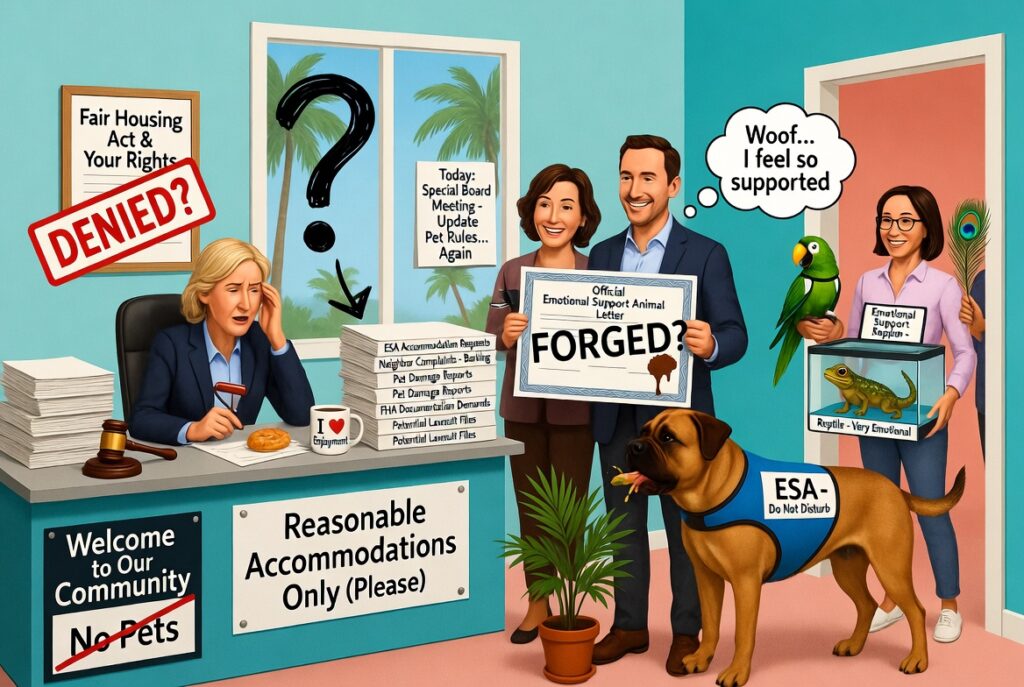
HUD Narrows Its Approach to Emotional Support Animal Requests: What Florida HOAs and Condominium Associations Should Know.

Florida ESA Issues

By: Alicia Pokhoy, Esq.

Florida condominium and homeowners associations regularly deal with requests for emotional support animals, especially in communities with pet restrictions, breed limits, weight limits, or no-pet policies. These requests can be difficult to evaluate and, if handled incorrectly, may expose associations to fair housing complaints or litigation.

On May 22, 2026, the U.S. Department of Housing and Urban Development (HUD), through its Office of Fair Housing and Equal Opportunity, issued new enforcement guidance that changes how HUD intends to evaluate certain animal-related reasonable accommodation complaints under the Fair Housing Act.

What Changed?

HUD has rescinded its prior guidance on assistance animals, including the 2020 framework that many housing providers previously relied on.

Under HUD’s new enforcement approach, the focus is now on whether the animal is individually trained to perform specific work or tasks directly related to the resident’s disability. HUD also made clear that emotional support, comfort, companionship, or general well-being, by themselves, do not qualify as trained work or tasks.

This is a significant shift. In practical terms, HUD may now be less likely to pursue enforcement actions involving untrained emotional support animals, particularly where the request is unsupported, vague, or based on generic online documentation.

Why This Matters for Florida Community Associations.

Condominium and HOA boards must balance fair housing obligations with the association’s governing documents, pet rules, insurance concerns, nuisance issues, and the rights of other residents.

HUD’s new guidance gives associations stronger support to carefully evaluate whether:

  • The animal is trained to perform disability-related tasks;
  • The requested accommodation is necessary;
  • The documentation is reliable; and
  • The request is supported by more than a generic online certificate or form letter.

This may be helpful for associations facing questionable ESA requests, multiple-animal requests, or requests that appear to be an attempt to avoid otherwise valid pet restrictions.

Associations Still Need to Be Careful.

The new HUD guidance is important, but it does not mean associations can automatically deny emotional support animal requests.

The guidance does not change the Fair Housing Act itself. Residents may still file private lawsuits in state or federal court. State and local fair housing laws may also provide additional protections. Courts will continue to review these disputes based on the specific facts of each case. For that reason, associations should avoid blanket policies or automatic denials.

Practical Steps for Boards and Managers.

Florida associations should consider the following:

  1. Review pet and animal policies to distinguish between pets, trained service or assistance animals, and emotional support animals.
  2. Update reasonable accommodation procedures so requests are handled consistently and in writing.
  3. Document the interactive process, including the request, supporting documents, follow-up questions, board review, and final decision.
  4. Avoid automatic denials, even when the animal is not clearly trained.
  5. Consult counsel before imposing pet fees, deposits, breed limits, weight limits, or other restrictions on an animal claimed as an accommodation.
  6. Monitor future developments, as HUD has indicated that additional rulemaking may follow.

Bottom Line.

HUD’s new enforcement guidance may provide welcome relief for Florida condominium and homeowners associations dealing with questionable emotional support animal requests. However, this area of law remains fact-specific and legally sensitive.

Associations should use this opportunity to review their pet policies, reasonable accommodation procedures, and board practices. Clear rules, consistent procedures, and careful documentation remain the best way to reduce risk.

Our firm assists Florida condominium and homeowners associations with pet policies, emotional support animal requests, reasonable accommodation procedures, board training, and fair housing compliance. If your association is dealing with an ESA request or wants to update its policies in light of HUD’s new guidance, contact us to discuss practical options for your community.

ACT NOW!

Stay one step ahead of new legislation, recent case law, and new developments that may impact your community association by subscribing to the Gerstin & Associates newsletter.

 Click Here to Subscribe to the Gerstin & Associates Newsletter

Here Come the Lawyers! US Supreme Court Declares Criminals Have a Right to Live in Your Community Association and a Right to Sue You for Trying to Stop Them

By Seth Amkraut, Esq.neighborhood_watch_05b

Click here for .pdf version of this article

Potential Personal Liability for Board Members.

Many community associations in Florida screen prospective buyers and tenants. This screening process typically includes a comprehensive background check into each applicant’s credit, rental, employment and criminal history.  Recently, an interpretation by the United States Department of Housing and Urban Development (“HUD”) of a recent United States Supreme Court Case, Texas Department of Housing and Community Affairs, et al v. Inclusive Communities Project, Inc., et al., severely curtailed community associations’ ability to deny sales or rentals to convicted criminals.  Enforcing blanket bans on convicted criminals purchasing or renting in your community can now subject both the community association and its Board members, individually, to liability.

With particularly awful circular reasoning, HUD issued an April 4, 2016, guidance memorandum declaring a higher percentage of adult minorities have criminal records when compared to the overall adult population.  Therefore, prohibiting a person with a criminal conviction to buy or rent in your community has a “disparate impact” on certain racial minorities tantamount to racial discrimination. Considering racial discrimination in housing violates federal law, HUD rounds the final corner and declares by extension the blanket use of criminal records to deny housing violates Federal law. This is a critical pronouncement effectively outlawing all blanket prohibitions on individuals with a criminal history and calls into question less restrictive policies. Even a narrowly tailored policy excluding only certain types of criminals must accurately distinguish between criminal conduct representing a genuine risk to other residents or property.

Making matters worse, HUD’s guidance on this issue shifts the long-standing burden requiring a Plaintiff to prove their case. Instead, community associations will be presumed to have discriminated against a proposed tenant or purchaser if a person within a protected class (e.g. a racial minority) is denied housing simply due to the person’s prior criminal record.   To rebut this presumption, community associations will have to prove the association’s denial of housing to persons with a “criminal history” actually assists in protecting resident safety and/or property. The only exception is for criminal convictions relating to manufacturing or distributing controlled substances. In essence, HUD has determined violent felons, such as murderers or rapists, are less dangerous than people manufacturing or distributing illegal drugs.

Individual board member liability.

As experienced Board members will tell you, often times upset owners (and their accommodating lawyers) name board members individually in lawsuits.  More often than not, these lawsuits are defended (and dismissed) by an association’s insurance counsel. However, most community insurance association policies will not offer coverage for housing discrimination or similar claims.  Without such coverage, both the association and the individual board members will have to pay out- of-pocket for representation and any resulting damages.  Although the individual board members may seek reimbursement from the Association (indemnification), claims for housing discrimination are known as intentional torts or intentional statutory violations. Typically, community associations are not required to indemnify individual board members against claims for damages related to intentional conduct. As you can surmise, the result of not a board member not being indemnified by his/her community association can be financially ruinous.

What can an association do? 

There is no one size fits all formula for creating Fair Housing Act compliant criminal background policies. In this new legal landscape, every community association that considers criminal history when evaluating prospective buyers and tenants must be prepared to defend the inevitable claims filed by rejected applicants.

Gerstin & Associates can assist your community association with drafting a criminal background policy allowing for the rejection of the most dangerous applicants while minimizing the risk of liability for discriminatory practices. Contact our office today for a free consultation.

Stay one-step ahead of new legislation, recent case law and new developments that impact your community association by subscribing to the Gerstin & Associates Community Association Newsletter.  Please complete and either email or fax the following to: (561) 750-8185 (no cover page needed).

Name: ____________________________      Association name: _____________________

Position at the association (director, property manager, etc.) _____________________

Email address: ______________________     Telephone number: __________________