Florida condominium and homeowners associations spend most of the year operating under rules that do not change. 2026 was not one of those years. Between a rewritten corporate statute, a new building-permit law, several appellate decisions, and a pair of federal developments that are not law at all, the rules governing Florida community associations moved in more places than the published summaries suggest.
Our firm’s 2026 Florida Community Association Legislative and Case Law Update is now available as a free handout for board members, officers, and licensed community association managers.
Download the 2026 Florida Community Association Legislative and Case Law Update here!
House Bill 797 rewrote Chapter 617, the Florida Nonprofit Corporation Act — the statute underneath every Florida condominium association’s and HOA’s articles of incorporation and bylaws. Effective July 1, 2026, Florida corporate law no longer requires a board of at least three directors, an owner’s records inspection rights may no longer be limited by the bylaws, and the procedure for approving a contract with a company connected to a director carries a new consequence if it is not followed. The change applies to your association whether or not anyone amended a governing document.
House Bill 803 limited architectural review. An association or its architectural review committee may no longer require an owner to obtain a building permit before the committee will review plans, and local governments must stop requiring permits for most single-family work under $7,500.
Florida’s appellate courts issued decisions that change enforcement practice. Two 2025 decisions pull in opposite directions on covenant enforcement litigation, and one is now pending before the Florida Supreme Court. A separate decision invalidated the records-request rule many associations have relied on for years.
Fannie Mae and Freddie Mac changed condominium project standards in March 2026. Limited Review was eliminated, and the share of the annual budget that must be allocated to reserves rises from 10% to 15% on January 4, 2027. Neither change required legislation, and a Florida association in full compliance with the structural integrity reserve study requirements can still find its units unfinanceable.
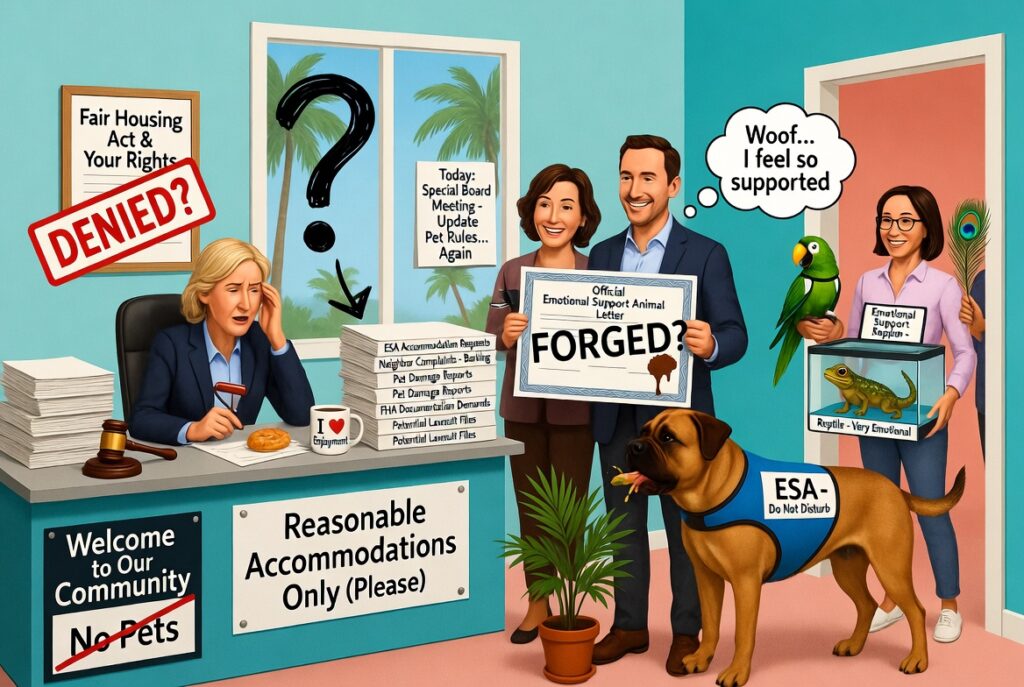
HUD withdrew its assistance animal guidance on May 22, 2026, changing how emotional support animal requests are evaluated at the federal enforcement level — though not changing the Fair Housing Act itself.
Most of what changed in 2026 does not arrive with a deadline. It surfaces when a question arises — a contested election, a records demand, a vendor dispute, a sale that will not close — and at that point the association’s documents and procedures are what they are.
The provisions most likely to affect a board this year are the ones least discussed in the published 2026 summaries, and several of them turn on language already sitting in your articles of incorporation and bylaws.
Have your attorney read your articles of incorporation and bylaws against the new Chapter 617, beginning with the provision fixing the number of directors.
Review your records inspection policy and remove any cap on how frequently an owner may request records and any certified-mail-only requirement.
Document interested-director contracts properly — written disclosure, the interested director out of the vote, competing bids retained in the file, and minutes that reflect it.
Put your architectural standards in writing, because standards that are not published may no longer be enforceable.
Confirm the percentage of your annual budget allocated to reserves, and the date of your last reserve study.
Evaluate every assistance animal request individually, and avoid blanket policies in either direction.
2026 was reported as a quiet legislative session for Florida community associations. It was not. The most consequential changes were made outside Chapters 718 and 720 — in the corporate statute, in the appellate courts, and by two federally chartered corporations that do not answer to the Florida Legislature at all.
Download the 2026 Florida Community Association Legislative and Case Law Update here!
Does HB 797 apply to my association if we never amended our governing documents?
Yes. Chapter 617 contains a reserved-power provision, and amendments to the Act reach corporations already organized under it. Which provisions actually affect your association depends on what your articles of incorporation and bylaws already say.
How many directors does a Florida condominium or HOA board need in 2026?
Florida corporate law no longer sets a minimum. If your articles of incorporation or bylaws fix a number, that number governs. If they only reference “the number required by law,” your association no longer has a minimum.
Can a Florida association limit how often an owner requests association records?
No. As of July 1, 2026, the inspection right may not be limited by the articles of incorporation or the bylaws, and a 2025 Fourth District Court of Appeal decision held that a rule capping requests by frequency is unenforceable as well.
What are the new Fannie Mae condominium reserve requirements?
Limited Review was eliminated effective August 3, 2026. The minimum share of the annual budget allocated to reserves rises from 10% to 15% on January 4, 2027. A lender may rely only on a reserve study completed within the last three years.
Can our association now deny emotional support animal requests?
No. HUD changed its enforcement posture, not the Fair Housing Act. Owners may still sue directly, and Florida has its own assistance animal statute. Evaluate each request individually and document the process.
Our firm represents Florida condominium and homeowners associations in governing document amendments, covenant enforcement, records requests, board training, and the full range of community association matters. To schedule a consultation for your community or your management portfolio, contact us at (561) 750-3456 or joshua@gerstin.com.
Florida condominium and homeowners associations regularly deal with requests for emotional support animals, especially in communities with pet restrictions, breed limits, weight limits, or no-pet policies. These requests can be difficult to evaluate and, if handled incorrectly, may expose associations to fair housing complaints or litigation.
On May 22, 2026, the U.S. Department of Housing and Urban Development (HUD), through its Office of Fair Housing and Equal Opportunity, issued new enforcement guidance that changes how HUD intends to evaluate certain animal-related reasonable accommodation complaints under the Fair Housing Act.
What Changed?
HUD has rescinded its prior guidance on assistance animals, including the 2020 framework that many housing providers previously relied on.
Under HUD’s new enforcement approach, the focus is now on whether the animal is individually trained to perform specific work or tasks directly related to the resident’s disability. HUD also made clear that emotional support, comfort, companionship, or general well-being, by themselves, do not qualify as trained work or tasks.
This is a significant shift. In practical terms, HUD may now be less likely to pursue enforcement actions involving untrained emotional support animals, particularly where the request is unsupported, vague, or based on generic online documentation.
Why This Matters for Florida Community Associations.
Condominium and HOA boards must balance fair housing obligations with the association’s governing documents, pet rules, insurance concerns, nuisance issues, and the rights of other residents.
HUD’s new guidance gives associations stronger support to carefully evaluate whether:
The animal is trained to perform disability-related tasks;
The requested accommodation is necessary;
The documentation is reliable; and
The request is supported by more than a generic online certificate or form letter.
This may be helpful for associations facing questionable ESA requests, multiple-animal requests, or requests that appear to be an attempt to avoid otherwise valid pet restrictions.
Associations Still Need to Be Careful.
The new HUD guidance is important, but it does not mean associations can automatically deny emotional support animal requests.
The guidance does not change the Fair Housing Act itself. Residents may still file private lawsuits in state or federal court. State and local fair housing laws may also provide additional protections. Courts will continue to review these disputes based on the specific facts of each case. For that reason, associations should avoid blanket policies or automatic denials.
Practical Steps for Boards and Managers.
Florida associations should consider the following:
Review pet and animal policies to distinguish between pets, trained service or assistance animals, and emotional support animals.
Update reasonable accommodation procedures so requests are handled consistently and in writing.
Document the interactive process, including the request, supporting documents, follow-up questions, board review, and final decision.
Avoid automatic denials, even when the animal is not clearly trained.
Consult counsel before imposing pet fees, deposits, breed limits, weight limits, or other restrictions on an animal claimed as an accommodation.
Monitor future developments, as HUD has indicated that additional rulemaking may follow.
Bottom Line.
HUD’s new enforcement guidance may provide welcome relief for Florida condominium and homeowners associations dealing with questionable emotional support animal requests. However, this area of law remains fact-specific and legally sensitive.
Associations should use this opportunity to review their pet policies, reasonable accommodation procedures, and board practices. Clear rules, consistent procedures, and careful documentation remain the best way to reduce risk.
Our firm assists Florida condominium and homeowners associations with pet policies, emotional support animal requests, reasonable accommodation procedures, board training, and fair housing compliance. If your association is dealing with an ESA request or wants to update its policies in light of HUD’s new guidance, contact us to discuss practical options for your community.
ACT NOW!
Stay one step ahead of new legislation, recent case law, and new developments that may impact your community association by subscribing to the Gerstin & Associates newsletter.
Florida condominium associations are entering a new phase of board governance in 2026 as statutory term limits for condominium directors begin to have a real, practical effect. While the law itself has been on the books for several years, the statute’s timing mechanism means many long-serving board members will first encounter these limits during upcoming election cycles.
Associations that plan ahead will be in a much better position to avoid election confusion, disputes, or last-minute eligibility issues.
Only board service occurring on or after July 1, 2018, counts toward the eight-year total. That delayed counting period is the reason many associations will first feel the impact of the term limit rule in 2026.
These term limits apply only to condominium associations governed by Chapter 718 of the Florida Statutes. Homeowners’ associations governed by Chapter 720 are not subject to the same statutory limits unless their governing documents independently impose them.
STATUTORY EXCEPTIONS TO THE TERM LIMIT
The law recognizes that some associations need flexibility and includes two important exceptions.
First, a director who has reached the eight-year limit may continue serving if the director receives an affirmative vote of two-thirds of all votes cast in the election. This is a higher threshold than a simple majority and requires clear owner support.
Second, a director may continue serving if there are not enough eligible candidates to fill all open board seats. This exception prevents associations from being left without a functioning board due to a lack of volunteers.
Both exceptions reflect a balance between encouraging board turnover and maintaining operational stability.
WHY THIS MATTERS FOR ASSOCIATION GOVERNANCE
Many condominium boards in Florida have historically relied on long-serving directors. Experience and institutional knowledge can be valuable, but indefinite service also carries risks, including stagnation, reduced owner participation, and increased election disputes.
Term limits introduce a formal structure that encourages leadership transition while still allowing flexibility when communities truly need it.
For boards, the key issue is not simply who has served the longest, but whether eligibility rules are being applied correctly and consistently.
WHAT BOARDS SHOULD BE DOING NOW
Boards should begin by auditing board service records going back to mid-2018. Accurate records are essential for determining when a director approaches the eight-year limit.
Election notices and ballots should be reviewed to confirm they reflect current statutory requirements, including eligibility standards and voting thresholds for exceptions.
Clear communication with unit owners is critical. Owners should understand how term limits work, why they exist, and how exception votes are counted. Transparency reduces confusion and builds confidence in the election process.
Associations should also review their governing documents to determine whether statutory amendments are automatically adopted and how those provisions interact with existing bylaws.
ACT NOW!
Stay one step ahead of new legislation, recent case law, and new developments that may impact your community association by subscribing to the Gerstin & Associates newsletter.
“ I am from the government and I am here to help.” This famous quote from former President Ronald Reagan perfectly sums up Florida’s recent legislative session. Click here for a .pdf copy of this article.
HB 913— Condominium Associations Effective July 1, 2025.
Addresses the affordability of mandated condo safety measures.
Provides immediate relief from the sudden cost burden of fee assessments by extending the reserve study requirement for one year and allowing for a 2 year pause in reserve fund contributions to prioritize funding critical repairs identified in a milestone inspection.
Increases the replacement cost of repairs required to be reserved and considered in the Structural Integrity Reserve Study (SIRS) from $10,000 to $25,000 to prioritize more critical repairs.
Provides alternate funding options that give associations flexibility as they work to meet reserve funding requirements, including an on-ramp for funding of items that still have useful life left.
The legislation reinforces requirements for milestone inspections and structural integrity reserve studies (SIRS). Associations must complete their first SIRS by December 31, 2025, and include a funding plan to support long-term structural needs.
Boards may pause or redirect reserve contributions in specific emergencies or inspections, but only with membership approval and in accordance with new statutory procedures. Board members must also sign an affidavit acknowledging receipt of completed SIRS, reinforcing their fiduciary responsibility.
Enhances accountability for condo associations.
Empowers boards and unit owners to terminate contracts if a manager fails to follow the requirements of the state’s condo laws.
Prohibits association managers whose license is revoked by DBPR from holding any role in a management firm or being licensed for 10 years.
Enhances oversight, transparency, and empowers condo owners to be more involved in the decision-making of their associations.
Requires full disclosure of potential conflicts of interest and mandates competitive bidding for contracts to make repairs on condominiums, protecting associations from self-dealing and ensuring fair value for owners.
Requires associations to provide more information and records online, making it easier for residents to access records and understand how their communities are managed, and money is spent. Additionally, it provides associations with the ability to deliver documents electronically, saving time and money.
Lays the groundwork for increased participation in community meetings by allowing for increased video conference usage and electronic voting.
Requires condo associations to report information about their property to DBPR and provide additional association details, for state regulatory oversight.
Mandates data sharing among local governments and state partners to better assess compliance with building safety requirements and understand the impact of reforms.
Promotes financial transparency.
Includes requirements for increased financial transparency and requires that unit owners have access to their associations’ financial records.
Allows associations more time to complete detailed financial reports.
Requires funding method and related details for SIRS to be disclosed to unit owners and potential buyers and extends the time from 3 to 7 days prospective buyers have to review financial information.
CS/CS/HB 393— My Safe Florida Condominium Pilot Program
The bill revises provisions of the My Safe Florida Condominium Pilot Program (Program) within the Department of Financial Services to:
Exclude detached units on individual parcels of land from the definition of “condominium.”
Limit participation in the Program to structures or buildings on the condominium property that are three or more stories in height and contain at least two single-family dwellings.
Prohibit an association application for an inspection or mitigation grant unless the windows of the subject property are established as common elements in the declaration and the association has complied with the inspection requirements in ss. 553.899 and 718.112(2)(g) and (h), F.S.
Require approval of at least 75 percent of all unit owners who reside within the structure or building that is the subject of the mitigation grant, rather than a unanimous vote of all unit owners.
Eliminate the restrictions that limit grant contributions to:
For a roof-related project, $11 per square foot multiplied by the roof’s square footage, not to exceed $1,000 per unit, with a maximum grant award of 50 percent of the project’s cost.
On an opening protection-related project, a maximum grant award of $750 per window or door, not to exceed $1,500 per unit, with a maximum grant award of 50 percent of the project’s cost.
Specify the roof mitigation techniques that may receive a grant award.
Require that the improvements must be verified during the final hurricane mitigation inspection to qualify for grant funds.
Provide that grant funds may only be used for water intrusion mitigation devices or mitigation improvements that will result in an insurance premium mitigation credit, discount, or other rate differential for the building or structure to which such device or improvement is applied or made.
Require that it is a condition of awarding a grant that mitigation improvements be made to all openings if doing so is necessary for the building or structure to qualify for a mitigation credit, discount, or other rate differential.
Stay one step ahead of new legislation, recent case law, and new developments that may impact your community association by subscribing to the Gerstin & Associates newsletter.
“A butterfly flaps its wings in Africa, and a hurricane lands in Florida six months later.” The same can be said about community associations. A few bad actors in one part of the state are caught, and six months later, an entirely new regulatory scheme for community associations is passed.
Known as “Condo 3.0,” the recently passed legislation affecting condominium associations is extensive. Plan ahead to avoid issues, the legislation goes into effect on July 1, 2024.
Although not as extensive as the condominium association legislation, homeowner associations were not spared extra regulation. The legislation affecting homeowners associations goes into effect on July 1, 2024.
CS/CS/CS/HB 1021 — Condominium Associations Effective July 1, 2024.
The bill requires community association managers (CAMs) and CAM firms to return all community association records in their possession within 20 business days of termination of a services agreement or a written request whichever occurs first, with license suspension and civil
penalties for noncompliance, except that the time frames applicable to timeshare plans apply to the records of a timeshare plan.
The bill provides conflict of interest disclosure requirements and a process for associations to follow when approving contracts with CAMs and CAM firms, or a relative, that may present a conflict of interest. The requirements are similar to the conflicts of interest provisions for condominium associations and their officers and directors, including:
Providing that, if the association receives and considers a bid to provide a good or service that exceeds $2,500, other than community association management services, from a CAM or CAM firm, including directors, officers, persons with a financial interest in a CAM firm, or a relative of such persons, the association must also solicit multiple bids from other third-party providers of such good or service.
Requiring that the proposed activity that may be a conflict of interest must be listed on, and all contracts and transactional documents related to the proposed activity must be attached to, the board’s meeting agenda and entered into the meeting minutes.
Requiring the board must approve the contracts with a potential conflict of interest, and all management contracts, by an affirmative vote of two-thirds of all directors present.
Milestone Inspections
Currently, single-family, two-family, and three-family dwellings are exempt from the milestone inspection requirements. The bill exempts four-family dwellings with three or fewer habitable stories above ground.
Official Records – Condominiums
Regarding access to the official records of a condominium association, the bill:
Provides that, if records are lost or destroyed, there is a good faith obligation to obtain and recover the records as is reasonably possible.
Allows e-mail addresses and facsimile numbers to be accessible to unit owners if consent to receive notice by electronic transmission has been provided.
Prohibits the sale or sharing of such personal information to third parties.
Effective January 1, 2026, decreases from 150 units to 25 units the threshold requirement for an association to maintain specified records available on the association’s website or on a mobile device.
Requires official records to be provided to the unit owner at no charge if the Division of Condominium, Timeshares, and Mobile Homes (division) within the Department of Business and Professional Regulation (DBPR) subpoenas records an association has failed to timely provide in response to a unit owner’s written request.
Requires associations to maintain additional financial records (e.g., invoices and other documentation that substantiates any receipt or expenditure).
Requires associations to respond to a records request with a checklist of all records provided.
Authorizes the division to request access to an association’s website to investigate complaints related to unit owner access to official records on such website.
Criminal Violations – Condominiums
The bill provides the following criminal penalties related to condominium associations, and the official records of the association:
Second degree misdemeanor for any director or member of the board or association to knowingly, willfully, and repeatedly violate (two or more violations within a 12-month period) any specified requirements relating to inspection and copying of official records of an association;
First degree misdemeanor for knowingly and intentionally defacing or destroying required accounting records, or failing to create or maintain required accounting records, with the intent of causing harm to the association or one or more of its members;
Third degree felony to willfully and knowingly refuse to release or produce association records, with the intent to avoid or escape detection, arrest, trial, or punishment for the commission of a crime, or to assist another person with such avoidance or escape;
Third degree felony for an officer, director, or manager of a condominium association to knowingly solicit, offer to accept, or accept a kickback; and
First degree misdemeanor for engaging in specified fraudulent voting activity, and knowingly aiding, abetting, or advising a person in the commission of a fraudulent voting activity related to association elections.
The bill provides that officers and directors charged with a criminal violation under ch. 718, F.S., are deemed removed from office and a vacancy declared.
Budgets, Financial Reporting, and Reserves – Condominiums and Cooperatives
Regarding condominium association budgets, financial reporting, and reserves, the bill:
Prohibits associations from reducing the required type of financial statement (compiled, reviewed, or audited financial statements) for consecutive years.
Requires associations to provide unit owners with a notice that the structural integrity reserve study (SIRS) is available for inspection and copying within 45 days of completion of the study. The notice may be provided electronically.
Allows associations to temporarily pause the funding of reserves or a reduce reserve funding if the entire condominium building is uninhabitable due to a natural emergency, as determined by the local enforcement agency, upon majority approval of the members.
Condominium and cooperative associations must notify the division within 45 days after the SIRS is completed. By January 1, 2025, the division must create a database of associations that have completed the SIRS. After December 31, 2024, the division must include in its annual report a list of all associations that have completed the SIRS.
Meetings of Condominium Associations
The bill requires:
Associations of 10 or more units to meet quarterly and four times each year the agenda must allow members to ask questions concerning the status of construction or repair projects, revenues and expenditures, and other condominium issues; and
The notice for meetings on assessments must include the cost and purpose of assessments and a copy of any proposed contract.
Director Education – Condominiums
The bill provides education requirements for the officers and directors of condominium associations to require:
Newly elected or appointed directors to submit both the written certification that they have read the association’s governing documents, will work to uphold the documents to the best of their ability and faithfully discharge their duties, and submit a certificate of completion of an approved condominium education course;
Four hours of training which includes instruction on milestone inspections, SIRS, elections, recordkeeping, financial literacy and transparency, levying of fines, and meeting requirements;
Directors to annually complete at least one hour of continuing education about recent changes to the condominium laws and rules during the past year; and
Association directors, excluding directors for a timeshare condominium, to certify, on a form provided by the division, that all directors have completed the required written certification and educational certificate requirements.
Voting in Condominium and Cooperative Associations
Regarding voting in condominium and cooperative associations, the bill:
Requires associations to notify a condominium unit owner or member that his or her voting rights may be suspended due to non-payment of a fee or other monetary obligation at least 90 days before an election.
Allows cooperative and condominium owners to consent to electronic voting in elections by using an electronic means of consent.
Provides that if the cooperative and condominium board authorizes online voting, the board must honor a unit owner’s request to vote electronically at all subsequent elections, unless the unit owner opts out.
Hurricane Protections – Condominiums
The bill revises the requirements for the installation of hurricane protection in a condominium building, including:
Creating a uniform definition for “hurricane protection;”
Requiring condominium declarations to delineate the responsibilities of unit owners and associations for the costs of maintenance, repair, and replacement of hurricane protections, exterior doors, windows, and glass apertures;
Providing a uniform procedure for approval of hurricane protection; and
Providing that unit owners are not responsible for the cost of removal and reinstallation of hurricane protection if the removal is necessary to repair condominium property.
SLAPP and Defamation Suits
The bill revises the prohibitions against “strategic lawsuits against public participation” or “SLAPP suits,” which occur when association members are sued by individuals, business entities, or governmental entities for matters arising out of a unit owner’s appearance and presentation before a governmental entity on matters related to the condominium association.
The bill includes condominium associations in the SLAPP suit prohibition, and protects unit owners who report complaints to government agencies or law enforcement, or make public statements critical of the operation or management of an association by prohibiting associations from:
Retaliating against unit owners, by increasing assessments, threatening to bring an action for possession or other civil action; and
Spending association funds in support of defamation, libel, or tortious interference actions against a unit owner.
Condominium Officers and Directors
The bill provides that the attendance of an officer or director at a meeting of the board is sufficient to constitute a quorum for the meeting and for any vote taken in his or her absence when the director is required to leave the room during the discussion and the taking of a vote on a contract in which the director, or his relative, has an interest.
Division of Condominium, Timeshares, and Mobile Homes
The bill expands the division’s post-turnover jurisdiction to include:
Procedures and records related to financial issues, including annual financial reporting, assessments for common expenses, fines, and commingling funds;
Elections, including election and voting requirements, and recall of board members;
The maintenance of and unit owner access to association records;
The procedural aspects of meetings, such as unit owner meetings, quorums, voting requirements, proxies, board of administration meetings, and budget meetings;
Disclosure of conflicts of interest;
Removal of a board director or officer under ch. 718, F.S.;
The procedural completion of structural integrity reserve studies; and
Any written inquiries by unit owners to the association.
In addition, the bill:
Requires that the division must refer to local law enforcement authorities any person it believes has engaged any criminal activity.
Provides that the division and the office of the condominium ombudsman may attend and observe any meeting of the board or any unit owner meeting, for the purpose of performing the duties of the division or the office of the ombudsman.
The division must submit findings by January 1, 2025, to the Governor, the President of the Senate, and the Speaker of the House of Representatives, of its review and recommendations of the website or application requirements for official records.
Condominium Ombudsman
The bill provides for the appointment of the Condominium Ombudsman by the DBPR secretary instead of the Governor, and deletes the requirement that the ombudsman must be an attorney.
Limitations on Actions by Condominium and Cooperative Associations
The bill provides that the statute of limitations and statute of repose for certain actions available to a condominium association or a cooperative association, will not begin to run until the unit owners have elected a majority of the members of the board of administration.
Pre-Sale Disclosures and Requirements
The bill revises the form in which the prospective purchaser of a condominium unit acknowledges receipt of specified documents to include a copy of the most recent annual financial statement and annual budget of the condominium association.
Effective October 1, 2024, the bill also:
Includes the annual financial statement and annual budget of the condominium association among the documents a nondeveloper seller of a unit must give to a prospective purchaser of a unit.
Allows developers of nonresidential condominiums the option of delivering to the escrow agent a surety bond or an irrevocable letter of credit with specified conditions, and
Revises escrow requirements for developers.
Condominiums Within a Portion of a Building or Within a Multiple Parcel Building The bill revises the definition for the term “condominium property” to mean “the lands, leaseholds, improvements, any personal property, and all easements and rights appurtenant
thereto, regardless of whether contiguous, which are subjected to condominium ownership.”
Effective October 1, 2024, the bill provides disclosure requirements for the creation of condominiums within a portion of a building or within a multiple parcel building. The association of a condominium created within a portion of a building or within a multiple parcel building has the right to inspect and copy the books and records upon which the costs for maintaining and operating the shared facilities are based and to receive an annual budget with respect to such costs.
Florida Building Commission – Water Intrusion Study
The bill also requires the Florida Building Commission to submit a report by December 1, 2024, to the Governor, the President of the Senate, the Speaker of the House of Representatives, and the chairs of the legislative appropriations committees and appropriate substantive committees with jurisdiction over ch. 718, F.S., of its review of the standards to prevent water intrusion through the tracks of sliding glass doors.
CS/CS/HB 1503 — Condominium Association Insurance Effective July 1, 2024.
The bill relates to using surplus lines of insurance for non-homesteaded homes (second homes).
HB 1503, will allow surplus lines carriers to make takeout offers on Citizens’ policies that cover second homes that are non-homesteaded. Some lawmakers had said this change would provide more options for snowbirds and others with vacation homes that have struggled to find affordable coverage and would take those properties off Citizens’ book of business.
HB 1029— Condominium Associations My Safe Florida Home
This bill creates a Condominium Pilot Program within the very popular My Safe Florida Home Program(Opens in a new window) that continues to be available to single family homes. Single family homeowners may get the free inspection and apply for their grant now. After July 1, 2024, the site will be updated to include condominium associations.
For condo associations to participate they must meet the following criteria:
Be located within 15 miles of a coastline.
To apply for a FREE state inspection, the condominium association must receive approval by majority vote of the board of directors or a majority vote of the total voting interests of the association.
To apply for a grant, an association must receive both of the following:
Approval by a majority vote of the board of directors or a majority vote of the total voting interests of the association to participate in a mitigation inspection.
A unanimous vote of all unit owners within the building that is the subject of the mitigation grant.
The votes required may take place at the annual budget meeting or at a unit owner meeting called for the purpose. Before a vote may be taken, the association must provide the unit owners a clear disclosure of the program on a form created by the department.
The president and treasurer of the board must sign the disclosure form indicating that a copy of the form was provided to each unit owner of the association. The signed disclosure form and the minutes from the meeting at which the unit owners voted to participate in the program must be maintained as part of the official records.
Within 14 days after an affirmative vote to participate in the program, the association must provide written notice to all unit owners of the decision.
CS/CS/HB 1203 — Homeowners’ Associations Effective July 1, 2024.
The bill relates to the governance of homeowners’ associations and the practice of the community association managers who manage those communities.
Community Association Managers
Regarding community association managers (CAMs) and CAM firms, the bill requires CAMs and CAM firms to:
Annually attend at least one member meeting or board meeting of the association;
Provide to community association members certain information, including the contact person, contact information, and the hours of availability;
Provide the community’s members upon request a copy of the contract between the association and the CAM or CAM firm;
Annually complete at least 10 hours of continuing education; and
Biennially complete at least five hours of continuing education that pertains to homeowners’ associations, three hours of which must relate to recordkeeping.
Official Records
The bill requires homeowners’ associations to:
Effective January 1, 2026, associations with 100 or more parcels, maintain a digital copy of specified official records for download on the association’s website or through an application on a mobile device.
Provide a copy of records or otherwise make the records available that are subpoenaed by a law enforcement agency within five days of receiving a subpoena.
Maintain official records for at least seven years, unless the governing documents of the association require a longer period of time.
Criminal Violations
The bill provides the following criminal penalties related to homeowners’ associations:
Second degree misdemeanor for any director or member of the board or association to knowingly, willfully, and repeatedly violate (two or more violations within a 12-month period) any specified requirements relating to inspection and copying of official records of an association with the intent of causing harm to the association or one or more of its members;
First degree misdemeanor for knowingly and intentionally defacing or destroying required accounting records, or knowingly and intentionally failing to create or maintain required accounting records, with the intent of causing harm to the association or one or more of its members;
Third degree felony to willfully and knowingly refuse to release or otherwise produce association records, with the intent to avoid or escape detection, arrest, trial, or punishment
for the commission of a crime, or to assist another person with such avoidance or escape; and
Third degree felony for an officer, director, or manager of a condominium association to knowingly solicit, offer to accept, or accept a kickback.
The bill also expands the current criminal prohibitions against fraudulent voting activity to provide it is a first degree misdemeanor for:
Knowingly aiding, abetting, or advising a person in the commission of a fraudulent voting activity related to association elections.
Agreeing, conspiring, combining, or confederating with at least one other person to commit a fraudulent voting activity related to association elections.
Having knowledge of a fraudulent voting activity related to association elections and giving any aid to the offender with intent that the offender avoid or escape detection, arrest, trial, or punishment.
·
Any officer or director charged with a criminal violation under ch. 720, F.S., must be removed from office and a vacancy declared.
Assisting Law Enforcement
The bill requires associations, if subpoenaed, to provide a copy of the requested records within five business days of receiving the subpoena and to assist law enforcement in any investigation to the extent permissible by law.
Financial Reporting
The bill:
Requires associations with 1,000 or more parcels to have audited financial statements; and
Prohibits associations from reducing the required type of financial statement (compiled, reviewed, or audited financial statements) for consecutive years.
Requirement to Provide Accounting
The bill allows association parcel owners to make a written request for a detailed accounting of any amounts owed to the association. If the association fails to provide the accounting within 15 business days of a written request, any outstanding fines of the requester are waived if the fine is more than 30 days past due and the association did not give prior written notice of the fines. It also prohibits parcel owners from requesting another detailed accounting within 90 days of such a request.
Education – Officers and Directors
The bill revises the education requirements for the directors of homeowners’ associations to:
Require a newly elected or appointed director to, within 90 days after being elected or appointment to submit a certificate of having completed the educational curriculum.
Require that the educational curriculum include training relating to financial literacy and transparency, recordkeeping, levying of fines, and notice and meeting requirements.
Require a director of an association that has:
Fewer than 2,500 parcels to complete at least four hours of continuing education annually.
2,500 or more parcels must complete at least eight hours of continuing education annually.
Enforcement of Covenants and Rules
The bill requires associations or an architectural, construction improvement, or other similar committee to:
Provide written notice to the parcel owner of the rule or covenant relied upon when denying the request for the construction of a structure or other improvement;
Not place limits on the interior of a structure or require review of HVAC, refrigeration, heating, or ventilating system not visible from a parcel’s frontage, an adjacent parcel, common area, or community golf course, if a substantially similar system has been previously approved; and
Not prevent a homeowner from installing or displaying vegetable gardens and clotheslines in areas not visible from the frontage or an adjacent parcel, an adjacent common area, or a community golf course.
Fines, Suspensions, and Liens
Associations must have a hearing before a committee to review a fine or suspension issued by the board, and the bill:
Requires the 14-day notice of the parcel owner’s right to a hearing to be in writing;
Requires the hearing to be held within 90 days of the notice of hearing;
Allows the committee to hold the hearing by telephone or other electronic means;
Requires written findings related to the violation to be provided within seven days of the hearing, the date the fine must be paid or the suspension fulfilled;
Requires the date by which the fine must be paid to be at least 30 days after delivery of the written notice of the committee’s decision; or
Prohibits attorney fees and costs based on actions taken by the board before the date set for the fine to be paid;
Allows that, if a violation and the proposed fine or suspension is not cured or the fine is not paid, reasonable attorney fees and costs may be awarded to the association, but may not begin to accrue until after the payment date of the fine or the appeal time has expired.
The bill prohibits homeowners’ associations from issuing a fine or suspension for:
Leaving garbage receptacles at the curb or end of the driveway less than 24 hours before or after the designated garbage collection day or time.
Leaving holiday decorations or lights up longer than indicated in the governing documents, unless such decorations or lights are left up for longer than one week after the association provides written notice of the violation to the parcel owner.
The bill also provides that homeowners’ associations may not prohibit a homeowner or others from parking:
A personal vehicle, including a pickup truck, in the property owner’s driveway or in any other area where they have a right to park.
A work vehicle, which is not a commercial motor vehicle, in the property owner’s driveway.
Their assigned first responder vehicle on public roads or rights-of-way within the homeowners’ association.
In addition, the governing documents may not prohibit a property owner from:
Inviting, hiring, or allowing entry to a contractor or worker on the owner’s parcel solely because the contractor or worker is not on a preferred vendor list of the homeowners’ association or does not have a professional or occupational license.
Operating a vehicle in conformance with state traffic laws, on public roads or rights-of- way or the property owner’s parcel, unless the vehicle is a commercial motor vehicle.
Electronic Voting
The bill allows members of a homeowners’ association to consent to electronic voting by using an electronic means of consent. Current law requires written consent to vote electronically.
Assessments
The bill permits only simple interest, not compound interest, to accrue on assessments and installments on assessments that are not paid when due.
ACT NOW!
Stay one step ahead of new legislation, recent case law, and new developments that may impact your community association by subscribing to the Gerstin & Associates newsletter.
On April 23, 2024, the Federal Trade Commission (FTC) reached a final decision on the Noncompete Rule (16 CFR 910). This rule addresses concerns regarding certain types of noncompete agreements that were deemed “unfair methods of competition”. The rule will become effective 120 days after its publication in the Federal Register. The FTC Rule can be found here.
Under the Noncompete Rule, most noncompete agreements for employees earning less than $151,164 per year will be prohibited, as well as those that arise from the sale of a business. This provision aims to protect employees’ rights and prevent undue restrictions on their ability to seek employment opportunities.
It is important to note that the Noncompete Rule includes significant changes compared to the previously proposed version. One notable change pertains to the requirements for employers to inform individuals who may have existing noncompete agreements those agreements are no longer valid. Employers will be obliged to adhere to certain notification procedures, ensuring individuals are properly informed about their rights and obligations concerning these agreements.
Undoubtedly, the new Rule law will face pushback and lawsuits that will try to stop its implementation. Stay tuned for regular updates.
Act Now!
Stay one step ahead of new legislation, recent case law, and new developments that may impact your community association by subscribing to the Gerstin & Associates newsletter.